.png)
Create Your First Project
Start adding your projects to your portfolio. Click on "Manage Projects" to get started


Corsi Blocks - Psychological Test
Project Type
Photography
Date
April 2023
Role
Researcher & Game Designer
Try out the experiment yourself:
https://scripting.neurotask.com/exp/CbxHyJtXNF
Link to full report:
https://docs.google.com/document/d/10qIG_7TtLax_yqORKaJr9H6S2XxcwfH5/edit?usp=sharing&ouid=111892742815107003901&rtpof=true&sd=true
INTRODUCTION
The battle for one’s attention has never been more prevalent in society than it is today. From social media draining us of our attention span and high-jacking our short-term reward systems to meditation claiming to improve focused attention and long-term rewards, these two arguably polar opposites are hot words on any person’s palette. This sparks the curiosity for a series of experimental designs to put these two-arch nemesis in a head-to-head battle for a series of attentional tests. This study will examine the effects of meditation and social media on human cognitive performance with the classical Corsi-Blocks test. It is hypothesized that participants with a guided 3-minute meditation when compared to participants exposed to 3 minutes of social media stimulus, will have higher Corsi-Block performance in the measure of more spans completed.
DESIGN
This Corsi-Blocks experiment was designed and administered through NeuroTask Scripting. The four primary visual parameters of the task are display characteristics, color, block size, and block arrangement.
Ten blocks were used and arranged by the pattern1 laid out in the appendix. The colors chosen were a white background with light grey blocks at opacity 0.7. Block size can be found in the appendix2. Changing the block parameters was considered but given the issues of variations across Corsi-Blocks experiment1, the arrangement was intentionally left the same as Dr. Jaap Murre’s model in order to help unification across tests.
RESULTS
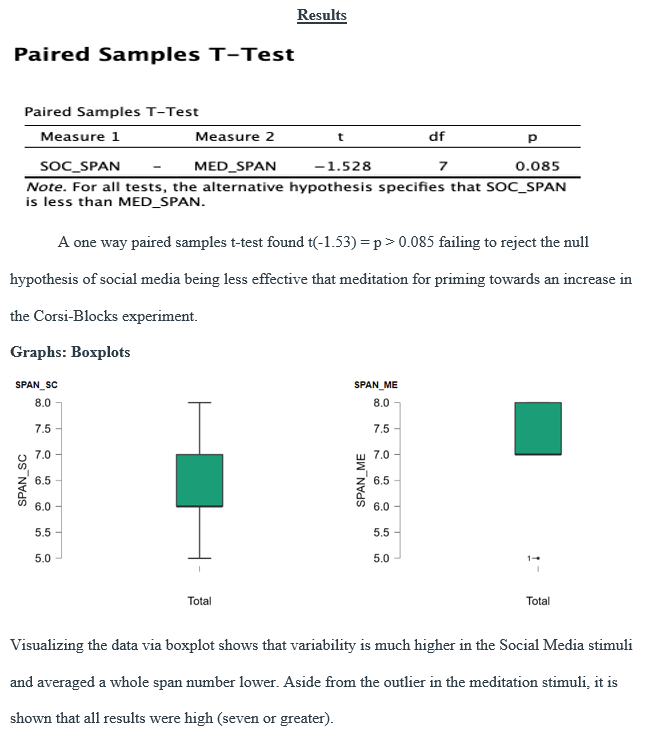
Visualizing the data via boxplot shows that variability is much higher in the Social Media stimuli and averaged a whole span number lower. Aside from the outlier in the meditation stimuli, it is shown that all results were high (seven or greater).